CSC 306 Introduction to Programming with C++
Introduction to Recursion
Chapter 13
Objectives
Important Definitions
- Recursion, recursive, base case, infinite recursion,
- stack, queue
- quick sort
|
There are 2 different kinds of people in the world... those who do not use
recursion and those who believe that:
|
|
There are 2 different kinds of people in the world... those who do not use
recursion and those who believe that
|
|
|
There are 2 different kinds of people in the world... those who do not use
recursion and those who believe that
|
|
Recursion
We have seen that it is legal in C++ for one function to call another.
This might lead you to wonder whether or not a function can call itself.
The answer is yes, and it turns out to be one of the most useful and interesting
things a function can do for certain applications.
The process of a function calling itself is called recursion because
the call to a function recurs in the current call of the same function.
Such functions are said to be recursive.
Example
Consider the following simple function:
|
|
void countdown( int n ) {
    if( n == 0 ) { // This is the situation when recursion stops.
	cout <<  "Blastoff!" << endl;
    }
    else {         // call the function recursively with n-1
	cout << n << endl;
	countdown (n-1);
    }
}
|
The function is called countdown(...) and it takes a single
integer as an argument.
If the parameter value is zero, it outputs the word "Blastoff."
Otherwise, it outputs the value in the parameter and then calls
countdown (itself) with the value of one minus the original
parameter as the argument (indicated in red).
Suppose we called the function like this:
|
|
void main () {
  countdown (3);
}
|
The execution of countdown looks like:
-
n=3 and because it is not zero, the function outputs the
value 3 to the console and then calls itself with the value
n-1 = 2
-
n=2 and because it is not zero, the function outputs the
value 2 to the console and then calls itself with the value
n-1 = 1
-
n=1 and because it is not zero, the function outputs the
value 1 to the console and then calls itself with the value
n-1 = 0
-
n=0 and because it is zero, the function outputs
the string "Blastoff" and returns (ends).
the function with n=1 ends and returns.
the function with n=2 ends and returns.
the function with n=3 ends and returns.
The main() function now ends.
Therefore, the total output looks like:
The Basic Idea
Recursion is a common idea in mathematics and logic, and simple recursion
consists of two parts:
- The base case:
the flow of execution of the function is such that the recursive call ends.
In other words, the function ends without making any more recursive
calls!
In the example above, it was when the countdown reached zero.
| Warning:
| Not having a base case or a poorly designed one can result in an
infinite recursion, which is VERY BAD!
|
- The recursive call:
The function must call itself again in order to continue processing
information.
When a function calls itself, something must be different so that
eventually, it will do the base case.
Note that if the function keeps doing the recursive call, it will
never end, resulting in, you guessed it, infinite recursion.
This is VERY BAD!
The reason by infinite recursion is a bad error is that in most
programming environments, a program with an infinite recursive function
can pretty easily fill up all of the avaiable memory and crash the
computer.
The Mechanics of a Recursive Call
It is easier to see how recusion works with the aid of a diagram of how the
execution works internally in the computer.
Technically speaking, C++ arranges the memory spaces needed for each function
call in a structure called a stack, which operates much like a stack
of trays.
The program calls the main() function when it starts, and space
is made on the stack for this function; at this point, it is the only thing
on the stack:
This space is used to store the temporary variables that main()
needs, a space to store the return value when it finishes and other information.
Each time a function is called, the memory area for that funtion is placed
on the top of the stack, and then taken off again when the execution of the
call is completed.
Therefore, when main() calls countdown(3), a new
memory area is created to for this function on top of the stack.
countdown calls itself three times until the base case is
reached when n=0, at which point the stack has five function calls
stored in it.
|
|
Program Start
|
Called countdown(3)
|
countdown()
n=2
|
countdown()
n=3
|
|
main()
|
Called countdown(2)
|
countdown()
n=1
|
countdown()
n=2
|
countdown()
n=3
|
|
main()
|
Called countdown(1)
|
countdown()
n=0
|
countdown()
n=1
|
countdown()
n=2
|
countdown()
n=3
|
|
main()
|
Called countdown(0)
|
As the functions end, they are at the top and are "popped" off the stack.
A stack is an example of a "last in/first out" structure (as opposed to,
for example, a queue, which is a "first in/first out" structure).
Two Mathematical Examples
- Natural Numbers:
These numbers can be loosely recursively defined as:
-
Base Case: 1 is a natural number
-
Recursion:
If N is a natural number, and N > 1,
then so is N-1.
- The Factorial (!)
-
Base Case: 0! = 1
-
Recursion:
If N is > 0, n! = n(n-1)!
By repeatedly using the definition of factorial, we can work out that
-
6 factorial = 6 x (5 factorial)
-
5 factorial = 5 x (4 factorial)
-
4 factorial = 4 x (3 factorial)
-
3 factorial = 3 x (2 factorial)
-
2 factorial = 2 x (1 factorial)
-
1 factorial = 1 x (0 factorial)
-
0 factorial = 1
The recurrence stops at the base case
1 factorial = 1 x 1 = 1
2 factorial = 2 x 1 = 2
3 factorial = 3 x 2 = 6
4 factorial = 4 x 6 = 24
5 factorial = 5 x 24 = 120
6 factorial = 6 x 120 = 720
We can code this recursive Factorial function in C++ as follows:
|
|
int Factorial(int n) {
    if (n == 0)                  // base case
	return 1;
    else                         // recursive call
	return n*Factorial(n-1);
}
|
Note how this code exactly mirrors the mathematical definition.
Students who have taken MAT105 or MAT315 should recognize that recursion
has a lot in common with mathematical induction.
Another Example
The following program on the left includes a call to the recursively defined
function print_backwards() that (1) inputs a series of characters
from the keyboard until it encounters a period, and then (2) prints them
backwards on the screen.
The one on the right, print_forwards(), inputs characters from the
input stream and outputs each one until the user types in a period.
|
|
#include<iostream>
using namespace std;

void print_backwards();  // function prototype

int main() {
    print_backwards();
    cout << "\n";

    return 0;
}

void print_backwards() {
    char character;

    cout << "Enter a character ('.' to end program): ";
    cin >> character;
    if (character != '.') {
	// output the character after the recursive call returns.
	print_backwards();
	cout << character;
    }
}
|
#include<iostream>
using namespace std;

void print_forwards();  // function prototype

int main() {
    print_backwards();
    cout << "\n";

    return 0;
}

void print_forwards() {
    char character;

    cout << "Enter a character ('.' to end program): ";
    cin >> character;
    if (character != '.') {
	// output the character, and then do recursive call
	cout << character;
	print_forwards();
    }
}
|
The only difference between the two is the placement of the cout
statement relative to the recursive call.
The function print_backwards() waits until the recursive call
returns before outputing the character input from the keyboard, while
print_forward() outputs the character first.
A typical run of print_backwards() might look like:
|
|
Enter a character ('.' to end program): H
Enter a character ('.' to end program): i
Enter a character ('.' to end program): .
iH
|
Recursion and Iteration
From a purely mechanical point of view, recursion is not absolutely
necessary because any function that can be defined recursively can also be
defined iteratively, i.e. defined using "for", "while" and "do...while" loops.
The iterative version of the Factorial(...) function can look like:
|
|
// Iterative version of the Factorial function
//precondition: n is positive
int Factorial(int n) {
    int product = 1;

    if (n == 0) {	// do nothing because product is already the factorial
    }
    else {		// calculate the factorial
	for (int i=n ; i > 0 ; i--)
	    product *= i;

    }
    return product;
}
|
Converting the print_forwards() function is relatively simple:
|
|
void print_forwards() {
    char chars;

    do {
	cout << "Enter a character ('.' to end program): ";
	cin >> chars;
	if( chars != '.' )
	    cout << chars;
    }
    while( chars != '.' ) ;
}
|
Converting the print_backwards() function is more involved because
we need more data structures to hold temporary data... In this case, we use
an array:
|
|
void print_backwards() {
    char chars[MAX_ARRAY_LENGTH];
    int no_of_chars_input = 0;

    // Note that unlike print_forwards(), we cannot ask the user for infinite
    // number of characters.
    do {
	cout << "Enter a character ('.' to end program): ";
	cin >> chars[no_of_chars_input];
	no_of_chars_input++;
    }
    while( chars[no_of_chars_input - 1] != '.'
	   && no_of_chars_input < MAX_ARRAY_LENGTH);

    for (int count = no_of_chars_input - 2 ; count >=0 ; count--)
	cout << chars[count];
    }
|
It is debatable whether using recursion or loops are clearere to understand
for a specific function.
Usually, an iterative definition will require more local variable declarations
- for example, the array chars[MAX_ARRAY_LENGTH] in the
print_backwards() example above, and the integer variable
product in the Factorial(...) function.
Temporary memory allocation is made explicit in the iterative versions of the
functions by declaring variables, whereas it is implicit in the recursive
definitions (the variable n has a different value depending on which
recursive call of countdown(...) it is local to).
This extra stack manipulation comes at a price, and recursive versions of
functions sometimes run slower and definately use more memory than their
iterative counterparts.
However, a function using recursion can sometimes be easier to understand
and run faster than the iterative version.
Quick Sort - A Recursive Procedure for Sorting
Consider the problem of sorting an array of elements.
We have already looked at selection sort and insertion sort that work with
nested loops to place the elements in ascending or descending order.
Quick sort is a fast a recursively defined sorting algorithm.
Why have different sorting algorithms?
It turns out that some algorithms perform much faster than others as the number
of elements in an array one needs to sort increases.
There is little difference in how long each of the sorting algorithms takes to
sort an array of small size (such as a single element).
However, this is not true as the number of elements in an array increases.
Both insertion and selection sort algorithms are substantially slower than
quick sort as the number of elements increases.
We will cover in CSC 320 this topic of comparing the relative speeds of
one algorithm versus another.
Suppose we start with the following array of 10 integers
(int a[10]):
The idea of quick sort is to separate the array into two parts by using an
element in the array called a pivot.
The left portion contains only values less than or equal to the pivot, and
the other will contain only values greater than or equal to the pivot.
Suppose we pick the pivot element 9.
The resulting parts are:
We can then reapply exactly the same process to the left-hand and right-hand
parts separately.
This re-application of the same quick sort procedure leads to a
recursive definition.
We create this arrangement as follows:
- Find a pivot point (P)
Suppose that first is the index of the first element and last
is the index for the last element of the array.
Often times, the index to act as a pivot point is found by calculating:
Note that in this example, we have integer division, so
P = (0+9)/2 = 4.
- Determine which elements to examine on both parts of the array separated by
the pivot
The left and right indexes (lft and rht) is initially set to the
extreme left and rightmost indexes, respectively.
Move the rht index to the left until the element it indexes is less than
or equal to the value of the pivot; the opposite applies the lft.
This is already true.
- Swap elements
If a[lft]>a[rht] swap the two values, which produces:
- Readjust position of lft and rht
Move lft to the right as long as a[lft] is less than or equal to
a[P].
On the opposite side, move rht to the left as long as a[rht] is
greater than a[P].
After this operation, the array is as follows:
- Swap values if necessary
If a[lft]>a[rht] swap the two values, which produces:
- Readjust position of lft and rht
Move lft to the right as long as a[lft] is less than or equal to
a[P].
On the opposite side, move rht to the left as long as a[rht] is
greater than a[P]:
- Swap the element values
- Move rht and lft again.
Now that lft >= rht is true, this part of the process stops.
- Recursive call
Perform the same steps on the left and right portions of the array.
Here is the quick sort procedure encoded as a C++ function:
|
|
//precondition: left < right.
void quick_sort(int list[], int left, int right) {
    int pivot, lft, rht;

    lft = left;
    rht = right;
    pivot = (left + right)/2; // integer division

    do {
	while( list[rht] > list[pivot] )
	    rht--;
    	while( list[lft] < list[pivot] )
	    lft++;
	if( lft <= rht ) {
	    swap( list[lft], list[rht] );
	    lft++;
	    rht--;
	}
    }
    while( rht >= lft );

    if( left < rht )
    	quick_sort(list, left, rht);
    if( lft < right )
    	quick_sort(list, lft, right);
}
|
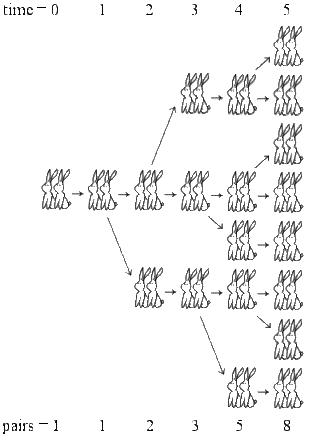
Fibonacci's Rabbits
An interesting original problem that Fibonacci investigated in the year
1202 was about how quickly rabbits could breed in ideal circumstances.
Suppose we start with a newly-born pair of rabbits, one male and one
female that are put in a field.
There are several assumptions we make about these rabbits:
-
Rabbits are able to mate at the age of one month so that at the end of
its second month a female can produce another pair of rabbits.
-
Our rabbits never die and
- The female always produces one new pair (one male, one female)
every month from the second month onwards.
|

|
The puzzle that Fibonacci posed was...
How many pairs will there be in one year?
- At the end of the first month, they mate, but there is still
one only 1 pair.
- At the end of the second month the female produces a new pair,
so now there are 2 pairs of rabbits in the field.
- At the end of the third month, the original female produces a
second pair, making 3 pairs in all in the field.
- At the end of the fourth month, the original female has
produced yet another new pair, the female born two months ago
produces her first pair also, making 5 pairs.
The number of pairs of rabbits in the field at the start of each month is
1, 1, 2, 3, 5, 8, 13, 21, 34, ...
|
|
Assignment Specifics
This assignment must be completed individually.
- Write a recursive function for a function that has one parameter n of type int that returns the nth Fibonacci number.
- The Fibonacci numbers are defined as follows:
- F(0)=1
- F(1)=1
- F(i+2)=F(i)+F(i+1) for i = 0, 1, 2, ...
- In other words, the Fibonacci numbers are the sum of the previous two numbers. Note that the first few Fibonacci numbers are 1, 1, 2, 3, 5, 8, ...
- Embed this recursive function in a program and test it.
Notes:
When you are finished writing and testing your assignment, drop the file with your
source code, YourLastName_306A19.cpp, into the CSC306_A19 dropbox on the
Academic server.